• Request Info
  • Visit
  • Apply
  • Give
  • Request Info
  • Visit
  • Apply
  • Give

Search

A-Z Index Map

Psychology & Neuroscience

  • About Psychology & Neuroscience
    • Employment Opportunities
    • Newsletter
    • All News
    • Faculty News Archive
    • Student News Archive
  • Undergraduate Students
    • About our Majors
    • Course Descriptions
    • Community Involvement
    • Undergraduate Research
    • Advising Center
    • Study Abroad
  • Graduate Students
    • Programs
    • Admissions
    • Financial Assistance
    • Ethical & Data Availability Issues
    • Forms
    • PGSA
    • Student Appeal
  • Research
    • Neuroscience and Behavior
    • Clinical Psychology
    • Counseling Psychology
    • Cognitive and Developmental Science
    • Social Psychology
  • People
    • Faculty
    • Emeritus
    • Adjunct
    • Part-Time Clinical
    • Staff
  • Psychological Clinic

Making good choices when life gets messy – practical wisdom relies on human judgment, not rules

Making good choices when life gets messy – practical wisdom relies on human judgment, not rules

Making good choices when life gets messy – practical wisdom relies on human judgment, not rules

March 11, 2026 by Kaitlin Coyle

no photo available

Making good choices when life gets messy – practical wisdom relies on human judgment, not rules

Profile
Tim Hulsey, University of Tennessee

A few semesters into my teaching career as a psychology professor, I uncovered a cheating ring. I determined who the ringleader was and called him to my office.

He admitted that he had illicitly obtained a copy of the exam and shared it with other students. He began to cry, telling me he was from a single parent family, the first in his family to go to college, and that his mother would be crushed if he was dismissed from the university for academic dishonesty.

I did not know what to do. I was angry at what he had done, but I also felt sorry for his situation. For reasons I still don’t fully understand, I decided to call his mother. When I told her what he had done, she apologized repeatedly, then said coldly, “Let me speak to him.”

I don’t know what she said, but as the color drained from his face and he was reduced to repeatedly saying, “Yes, ma’am,” I assumed he was being read the riot act. After he hung up, he headed home to, I suspect, more severe punishment than the university could have given. He received a “0” on the exam and an official reprimand in his student file, but I’m willing to bet that the most important lesson he learned didn’t come from the university or me.

Though I didn’t yet know the word, the decision to call his mother was an example of phronesis, an ancient Greek word usually translated as “practical wisdom.” It refers to the ability to make good decisions in real-life situations, especially when there are no clear rules or easy answers.

Charioteer of the virtues, guiding them all

Phronesis provides you with the ability to deliberate well about what is good and bad in specific circumstances. Unlike theoretical knowledge (sophia) or technical skill (techne), phronesis is about judgment – how to choose the right action at the right time for the right reasons.

When you think about wisdom, maybe you imagine a philosopher pondering big questions or a scientist unlocking the secrets of the universe. But phronesis is a different kind of wisdom, one that is less about abstract ideas and more about navigating the messy, unpredictable realities of everyday life. Phronesis helps you live well, not by following rules, but by making wise choices in the face of complexity. It’s what allows you to turn knowledge into action that is then beneficial.

Phronesis is a central component of the virtue approach to character development and morality first described by Aristotle. Virtues like courage, generosity, justice and temperance tell you what goals you should aim for, but they don’t tell you how much, when or in what way you should act in a specific situation. Phronesis helps you think through and decide the right means to achieve the right ends in the moment.

Aristotle called phronesis “the charioteer of the virtues” because it provides the guidance system that ensures the other virtues are applied correctly in real life. As he put it, “It is impossible to be good in the strict sense without practical wisdom.”

Let’s take the example of courage. Everyone wants to be brave and stand up for their values. However, without phronesis, too much courage may become recklessness, or too little courage could result in cowardice. Phronesis allows you to know when to take a risk and when to hold back.

Or consider justice, the virtue of treating others fairly. Phronesis allows you to choose what is fair in a specific situation. Virtues set the goals – for instance, “be courageous” or “be just” – but phronesis determines the right way to achieve them.

Practice phronesis in the face of complexity

Developing phronesis takes time and effort. It requires experience, reflection and careful reasoning. Because phronesis is social, it thrives in environments where people share their perspectives and challenge each other’s assumptions.

You don’t have to be a philosopher or a scientist to practice phronesis. Modern life is full of complexity. We are regularly faced with questions that don’t have clear answers.

Picture a parent who must decide whether to enforce bedtime or allow a child to stay up for a special family occasion. The rule says bedtime is nonnegotiable, but practical wisdom reminds us of the value of shared family experiences.

Or consider a manager who notices an employee missing deadlines. Instead of simply reprimanding them, they might ask what’s going on and discover a family emergency. They could adjust expectations and offer support, balancing fairness with compassion.

These kinds of decisions reflect practical wisdom because they anticipate future needs, not just rules or consequences.

In a world obsessed with data and efficiency, phronesis reminds us that human judgment still matters. Algorithms can optimize processes, but they can’t weigh moral values or capture the subtleties of human relationships. Whether in education, health care, business or politics, decisions that affect lives require more than technical expertise. They require wisdom.

Phronesis counters the illusion that life’s problems have simple, one-size-fits-all solutions. It helps us realize that good judgment takes time, empathy and reflection. So, the next time you face a tough decision, pause and ask: What’s the wise thing to do?The Conversation

Tim Hulsey, Associate Professor of Psychology, University of Tennessee

This article is republished from The Conversation under a Creative Commons license. Read the original article.

Filed Under: Faculty, Faculty News, Featured

Burghardt Paper Earns Biosemiotics Award

Burghardt Paper Earns Biosemiotics Award

October 8, 2025 by Kaitlin Coyle

no photo available

Burghardt Paper Earns Biosemiotics Award

Profile

Filed Under: Faculty News

New Name Reflects Neuroscience Growth at UT

New Name Reflects Neuroscience Growth at UT

July 3, 2025 by Logan Judy

no photo available

New Name Reflects Neuroscience Growth at UT

Profile

Filed Under: Faculty News, Featured

The Conversation: ‘With Hooters on the verge of bankruptcy, a psychologist reflects on her time spent studying the servers who work there’

The Conversation: ‘With Hooters on the verge of bankruptcy, a psychologist reflects on her time spent studying the servers who work there’

April 2, 2025 by Logan Judy

no photo available

The Conversation: ‘With Hooters on the verge of bankruptcy, a psychologist reflects on her time spent studying the servers who work there’

Profile
photo of a Hooters server
Servers told researchers that they were instructed to make their male customers feel special. Brian Brainerd/The Denver Post via Getty Images
Dawn Szymanski, University of Tennessee

In 1983, six businessmen got together and opened the first Hooters restaurant in Clearwater, Florida. Hooters of America LLC quickly became a restaurant chain success story.

With its scantily clad servers and signature breaded wings, the chain sells sex appeal in addition to food – or as one of the company’s mottos puts it: “You can sell the sizzle, but you have to deliver the steak.” It inspired a niche restaurant genre called “breastaurants,” with eateries such as the Tilted Kilt Pub & Eatery and Twin Peaks replicating Hooters’ busty business model.

A decade ago, business was booming for breastaurant chains, with these companies experiencing record sales growth.

Today it’s a different story. Declining sales, rising costs and a large debt burden of approximately US$300 million have threatened Hooters’ long-term outlook. In summer 2024, the chain closed over 40 of its restaurants across the U.S. In February 2025, Bloomberg reported that the company was on the verge of filing for bankruptcy.

Hooters isn’t necessarily going away for good. But it’s certainly looking like there will be fewer opportunities for women to work as “Hooters Girls” – and for customers to ogle at them.

As a psychologist, I was originally interested in studying servers at breastaurants because I could sense an interesting dynamic at play. On the one hand, it can feel good to be complimented for your looks. On the other hand, I also wondered whether constantly being critiqued might eventually wear these servers down.

So my research team and I decided to study what it was like to work in places like Hooters.

In a series of studies, here’s what we found.

Concocting a male fantasyland

More so than most restaurants, managers at breastaurants like Hooters seek to strictly regulate how their employees look and act.

For one of our studies, we interviewed 11 women who worked in breastaurants.

Several of them said that they were told to be “camera ready” at all times.

One described being given a booklet with exacting standards outlining her expected appearance, down to “nails, hair, makeup, brushing your teeth, wearing deodorant.” She had to promise to stay the same weight and height, wear makeup every shift and not change her hairstyle.

Beyond a carefully constructed physical appearance, the servers relayed that they were also expected to be confident, cheerful, charming, outgoing and emotionally steeled. They were instructed to make male customers feel special, to be their “personal cheerleaders,” as one interviewee put it, and to never challenge them.

Suffice it say, these demands can be unrealistic – and many of the servers we interviewed described becoming emotionally drained and eventually souring on the role.

‘The girls are a dime a dozen’

It probably won’t come as a surprise that Hooters servers often encounter lewd remarks, sexual advances and other forms of sexual harassment from customers.

But because their managers often tolerate this behavior from customers, it created the added burden of what psychologists call “double-binds” – situations where contradictory messages make it impossible to respond properly.

For example, say a regular customer who’s a generous tipper decides to proposition a server. Now she’s in a predicament. She’s been instructed to make customers feel special. And he’s already left a big tip, in addition to being a regular. But she also feels creeped out, and his advances make her feel worthless. Should she push back?

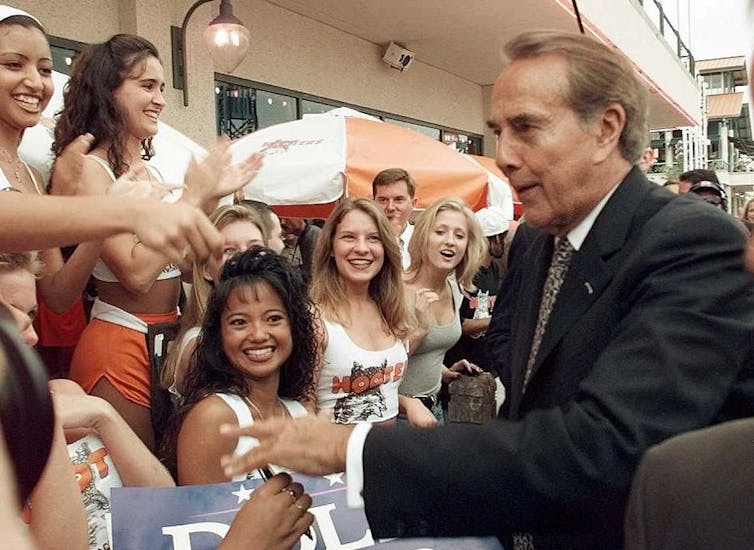
Older man in suit greets crowd of young women dressed in white and orange.
GOP presidential candidate Bob Dole shakes hands with Hooters employees after a campaign rally in Jacksonville, Fla., in 1996. J. David Ake/AFP via Getty Images

You might assume that managers, aware that their scantily clad employees would be more likely to face harassment, would try to set boundaries and throw out customers who treated servers poorly. But we found that waitresses at breastaurants have less support from both management and their co-workers than servers at other restaurants.

“Unfortunately, the girls are a dime a dozen, and that’s how they’re treated,” a former server and corporate trainer at a breastaurant explained.

The lack of co-worker support might also come as a surprise. Rather than standing in solidarity, the servers tended to compete for favoritism, better shifts and raises from their bosses. Gossiping, name-calling and scapegoating were commonplace.

The psychological toll

My research team also wanted to learn more about the specific emotional and psychological costs of working in these types of environments.

Psychologists Barbara Fredrickson and Tomi-Ann Robert have found that mental health problems that disproportionately affect women often coincide with sexual objectification.

So we weren’t surprised to find that servers working in sexually objectifying restaurant environments, such as Hooters and Twin Peaks, reported more symptoms of depression, anxiety and disordered eating than those working in other restaurants. In addition, they wanted to be thinner, were more likely to monitor their weight and appearance, and were more dissatisfied with their bodies. Hooters didn’t reply to a request for comment on this story.

Why are women drawn to the job?

Given our findings, you might wonder why any women would choose to work in places like Hooters in the first place.

The women we interviewed said that they sought work in breastaurants to make more money and have more flexibility.

A number of servers in one of our studies noted that they could make more money this way than waitressing at a regular restaurant or in other “real” jobs.

For example, one of the servers we interviewed used to work at a more run-of-the-mill restaurant.

“It was OK, I made OK money,” she told us. “But working at Hooters … I’ve walked out with hundreds of dollars in one shift.”

All the women we interviewed were in college or were mothers. So they enjoyed the high degree of flexibility in their work schedule that breastaurants provided.

Finally, several of them had previously experienced objectification while growing up, or they’d participated in activities centered on physical appearance, such as beauty pageants and cheerleading. This likely contributed to their decision to work at a Hooters or one of its competitors: They’d been objectified as adolescents, and so they found themselves drawn to these kinds of setting as adults.

Even so, our research suggests that the financial rewards and flexibility of working in breastaurants probably aren’t worth the potential psychological costs.The Conversation

Dawn Szymanski, Professor of Psychology, University of Tennessee

This article is republished from The Conversation under a Creative Commons license. Read the original article.

Filed Under: Faculty News, Featured

Psychology Study Focusing on Latinx LGBTQ Youth

Psychology Study Focusing on Latinx LGBTQ Youth

December 6, 2024 by Logan Judy

no photo available

Psychology Study Focusing on Latinx LGBTQ Youth

Profile

Filed Under: Faculty News

Call for Proposals: Connecting Across Disciplines 2025 Conference

Call for Proposals: Connecting Across Disciplines 2025 Conference

November 20, 2024 by Logan Judy

no photo available

Call for Proposals: Connecting Across Disciplines 2025 Conference

Profile

Filed Under: Faculty News, Featured, Student News

Burghardt honored by Animal Behavior Society

Burghardt honored by Animal Behavior Society

August 8, 2024 by Logan Judy

no photo available

Burghardt honored by Animal Behavior Society

Profile

Animal behavior captivated Gordon Burghardt as a boy, and over more than half a century at the University of Tennessee, Knoxville, his interdisciplinary research advanced ethology in areas including animal play, social behavior, communication, reptile behavior, enrichment, and animal cognitive abilities. 

The Animal Behavior Society (ABS) recognized his outstanding lifetime achievement by awarding Burghardt the 2024 Distinguished Animal Behaviorist Award during its annual meeting in late June.

Interest to Interdisciplinary Investigation

During his childhood in Wisconsin, Burghardt collected snakes. He also developed an interest in chemistry, and that was his major when he entered the University of Chicago in 1959. Despite his curiosity about animals, Burghardt said, “I was always told you couldn’t make a career, support a family, studying biology at that time.”

A class on animal behavior with Eckhard Hess led Burghardt to major in biopsychology, earning his PhD in 1966. He was drawn to UT by the head of the Department of Psychology and Neuroscience, William S. Verplanck, who had worked with B.F. Skinner and other leading psychologists. 

“The faculty were bright and young and growing, and they had a lot of people in experimental psychology working with animals,” Burghardt said. “I came, and I’ve been able to develop my own programs and courses, and had many grad students doing research.”

He founded a UT interdisciplinary Life Sciences Graduate Program in Ethology in 1981, one of several designed to break down departmental silos. 

Although Burghardt started as an assistant professor in the Department of  Psychology in 1968, he was always involved with the Department of Zoology and its graduate students. He noted the interdepartmental cooperation and collegial, supportive relationships within and between departments. “That’s developed even more now,” he said, pointing to the number of joint appointments. “I was the first one,” he said, also becoming a professor in the Department of Zoology in 1995 (now the Department of Ecology and Evolutionary Biology, or EEB).

Burghardt has worked with chemists, too, to research snakes’ chemical senses. He became one of the first editorial board members of The Journal of Chemical Ecology, one of numerous publications on which he has worked. He has served in leadership positions with multiple professional organizations too, including ABS and the American Psychological Association.

Burghardt’s excitement is evident when he talks about the first time he observed neonate snakes responding to prey chemicals, and he’s still publishing research on snake chemoreception.

Studying Play

Shortly after Burghardt arrived at UT, the university forged a relationship with the Great Smoky Mountains National Park for research on black bears, which were experiencing troubling encounters with tourists.

In 1970, two cubs found in the Smokies without their mother spent about seven weeks at Burghardt’s Knoxville home, until an area was ready for them in the park. The experience gave him an unusual observation opportunity. 

“They were super playful,” Burghardt said. “They were the most playful animals that I’ve ever seen.” 

That opened a new area for research, and Burghardt not only developed a definition of play but with his colleagues was the first to definitively document play in fish, turtles, and other species.

In 2005, his book The Genesis of Animal Play: Testing the Limits (MIT Press) examined the origins and evolution of play, reviewing evidence from species ranging from human babies to lizards, sharks, octopus, and insects. He has contributed to several other books on the topic, and his research also is extensively cited in the 2024 book Kingdom of Play: What Ball-bouncing Octopuses, Belly-flopping Monkeys, and Mud-sliding Elephants Reveal about Life Itself, by David Toomey.

Serpents, Iguanas, and Other Reptiles

Burghardt’s fascination with snakes led to numerous studies, with subjects ranging from neonates to a two-headed rat snake named IM that lived for decades in his lab.

He also taught a course on the psychology of religion, when it was a joint course with the Department of Religious Studies. “Snakes are the most important animal in religions,” he said, pointing around his office in the Austin Peay Memorial Building to artifacts and books from several faiths.

A trip to Panama to look at snakes led to his research on social behavior of newly hatched iguanas, uncovering social complexity unheard of in reptiles. Burghardt was unable to attend the ABS ceremony in Ontario to receive his award because it conflicted with his attending a centennial symposium at Barro Colorado Island, part of the Smithsonian Tropical Research Institute, where he and his students observed the iguanas. 

He and then-student Brian Bock served as scientific advisors on a British Broadcasting Corp. episode of Wildlife on One, “Iguanas, Living Like Dinosaurs,” narrated by David Attenborough. 

Burghardt and his colleagues also studied a Komodo dragon named Kraken at the Smithsonian’s National Zoo and later a Komodo dragon at Zoo Knoxville, also featured in two documentary films on play.

He is co-author of the 2021 book The Secret Social Lives of Reptiles and editor on the second edition of Health and Welfare of Captive Reptiles.

“It was really important that the university supported and appreciated the kind of stuff that I was doing, even though it was not at all traditional in terms of what psychologists typically do,” he said. “My work, I think, has been pretty well recognized, as this award shows, so I was on to something.”

While Burghardt still serves on a couple committees of graduate students completing their dissertations, he notes that some of his former students are retiring.

“I just retired two years ago, but they’re not hanging on until 80, like I did,” he said. “Doing my research, what I wanted to do, keeps you younger.” 

“I really love the field of animal behavior and feel that I’m still able to make substantial contributions,” said Burghardt, who in addition to publishing his own research is founding editor of a new journal, Frontiers in Ethology.

By Amy Beth Miller

Filed Under: Faculty News, Featured

Garriy Shteynberg in ‘The Conversation’ Podcast: Sharing that moment: can collective experiences bring people closer together?

Garriy Shteynberg in ‘The Conversation’ Podcast: Sharing that moment: can collective experiences bring people closer together?

July 24, 2024 by Logan Judy

no photo available

Garriy Shteynberg in ‘The Conversation’ Podcast: Sharing that moment: can collective experiences bring people closer together?

Profile
Gemma Ware, The Conversation

Across the world, fans will soon be tuning in at all hours of the day and night to watch the Paris Olympics. In a world where on-demand media streaming is now increasingly the norm, sport is something of a rarity. It’s watched live, often with other people. The joy, or heartbreak, is shared.

Can something as simple as watching a sporting competition at the same time bring people closer together? In this episode of The Conversation Weekly podcast, we explore this question with a psychologist who studies the impact of shared experiences.

In his experimental psychology lab at the University of Tennessee, Garriy Shteynberg creates situations in which his test subjects go through an experience together. “We’re trying to amp up this feeling of shared experience or shared attention,” he explains. It could be watching a video together, something sad, or funny. Or asking people to work towards a goal, such as memorising a list of words.

The results suggest that, when compared to control conditions in which someone experiences something alone or at a slightly different time to others, the shared attention of experiencing something together amplifies the experience and can even give people more motivation to complete a task.

We found that if I give you a surprise test after the fact, if you co-experience the list of words, you’re better able to recall that list versus if you experience them alone. If we co-experience an emotional scene, we find that people feel more emotional … so if it’s a happy scene, people feel happier … if it’s a sad scene … people feel sadder. It amplifies whatever that stimulus is.

Collective mind

Shteynberg’s experiments led him to develop what he calls the theory of the collective mind.

The idea is that our individual minds not only track where we diverge, but they also track where we converge with others. When you create a collective mind, it’s as if the perspective broadens, it becomes a “we perspective”.

His own experience of immigrating to the US from the Soviet Union as a child influences Shteynberg’s thinking about collective perspectives.

In the Soviet Union, collective consciousness was emphasised all the time. In the United States, it’s quite the opposite. Most of the time, collective consciousness is something to be afraid of. It is something that put in the background. You want individual consciousness, individual reasoning. Both of those outlooks are mistaken in a way.

He argues that people have individual thoughts and experiences, and simultaneously, they also have collective ones. Both of those matter to how they experiences the world.

Shteynberg is now interested in whether shared experiences can also help bring people together, particularly in the context of increasing political polarisation.

Shared experiences form this minimal social connection that doesn’t require us to share identities, ideologies or even beliefs … The idea that we are in the same room together, that we might be watching the same news is an important social bridge upon which things can be built.

Shteynberg says that in many different ways, irrespective of their politics, people believe they share a basic experience with others, whether that’s how they live, work, or even watching something like the Olympics on TV.

I think the focus being on the deep division and that always being front and centre of our shared experience obscures the fact that we are in fact of collective mind to a great number of things.

To listen to the full interview with Garriy Shteynberg about his research, subscribe to The Conversation Weekly podcast, which also features Maggie Villiger, senior science editor at The Conversation in the US. You can also read an article Shteynberg wrote about his research on the collective mind.


We’re running a listener survey to hear what you think about The Conversation Weekly podcast. It should take just a few minutes of your time and we’d really appreciate your thoughts. Please consider filling it in.

A transcript of this episode is available on Apple Podcasts.

Newsclips in this episode from BBC Sport.

This episode of The Conversation Weekly was written and produced by Katie Flood with assistance from Mend Mariwany. Sound design was by Eloise Stevens, and our theme music is by Neeta Sarl.

You can find us on Instagram at theconversationdotcom or via email. You can also subscribe to The Conversation’s free daily email here.

Listen to The Conversation Weekly via any of the apps listed above, download it directly via our RSS feed or find out how else to listen here.The Conversation

Gemma Ware, Host, The Conversation Weekly Podcast, The Conversation

This article is republished from The Conversation under a Creative Commons license. Read the original article.

Filed Under: Faculty, Faculty News, Featured

The Conversation: ‘Animal behavior research is getting better at keeping observer bias from sneaking in – but there’s still room to improve’

The Conversation: ‘Animal behavior research is getting better at keeping observer bias from sneaking in – but there’s still room to improve’

May 6, 2024 by Logan Judy

no photo available

The Conversation: ‘Animal behavior research is getting better at keeping observer bias from sneaking in – but there’s still room to improve’

Profile
What you expect can influence what you think you see. Auscape/Universal Images Group via Getty Images

Todd M. Freeberg, University of Tennessee

Animal behavior research relies on careful observation of animals. Researchers might spend months in a jungle habitat watching tropical birds mate and raise their young. They might track the rates of physical contact in cattle herds of different densities. Or they could record the sounds whales make as they migrate through the ocean.

Animal behavior research can provide fundamental insights into the natural processes that affect ecosystems around the globe, as well as into our own human minds and behavior.

I study animal behavior – and also the research reported by scientists in my field. One of the challenges of this kind of science is making sure our own assumptions don’t influence what we think we see in animal subjects. Like all people, how scientists see the world is shaped by biases and expectations, which can affect how data is recorded and reported. For instance, scientists who live in a society with strict gender roles for women and men might interpret things they see animals doing as reflecting those same divisions.

The scientific process corrects for such mistakes over time, but scientists have quicker methods at their disposal to minimize potential observer bias. Animal behavior scientists haven’t always used these methods – but that’s changing. A new study confirms that, over the past decade, studies increasingly adhere to the rigorous best practices that can minimize potential biases in animal behavior research.

Black and white photo of a horse with a man and a small table between them displaying three upright cards.
Adding up? Karl Krall/Wikimedia Commons

Biases and self-fulfilling prophecies

A German horse named Clever Hans is widely known in the history of animal behavior as a classic example of unconscious bias leading to a false result.

Around the turn of the 20th century, Clever Hans was purported to be able to do math. For example, in response to his owner’s prompt “3 + 5,” Clever Hans would tap his hoof eight times. His owner would then reward him with his favorite vegetables. Initial observers reported that the horse’s abilities were legitimate and that his owner was not being deceptive.

However, careful analysis by a young scientist named Oskar Pfungst revealed that if the horse could not see his owner, he couldn’t answer correctly. So while Clever Hans was not good at math, he was incredibly good at observing his owner’s subtle and unconscious cues that gave the math answers away.

In the 1960s, researchers asked human study participants to code the learning ability of rats. Participants were told their rats had been artificially selected over many generations to be either “bright” or “dull” learners. Over several weeks, the participants ran their rats through eight different learning experiments.

In seven out of the eight experiments, the human participants ranked the “bright” rats as being better learners than the “dull” rats when, in reality, the researchers had randomly picked rats from their breeding colony. Bias led the human participants to see what they thought they should see.

Eliminating bias

Given the clear potential for human biases to skew scientific results, textbooks on animal behavior research methods from the 1980s onward have implored researchers to verify their work using at least one of two commonsense methods.

One is making sure the researcher observing the behavior does not know if the subject comes from one study group or the other. For example, a researcher would measure a cricket’s behavior without knowing if it came from the experimental or control group.

The other best practice is utilizing a second researcher, who has fresh eyes and no knowledge of the data, to observe the behavior and code the data. For example, while analyzing a video file, I count chickadees taking seeds from a feeder 15 times. Later, a second independent observer counts the same number.

Yet these methods to minimize possible biases are often not employed by researchers in animal behavior, perhaps because these best practices take more time and effort.

In 2012, my colleagues and I reviewed nearly 1,000 articles published in five leading animal behavior journals between 1970 and 2010 to see how many reported these methods to minimize potential bias. Less than 10% did so. By contrast, the journal Infancy, which focuses on human infant behavior, was far more rigorous: Over 80% of its articles reported using methods to avoid bias.

It’s a problem not just confined to my field. A 2015 review of published articles in the life sciences found that blind protocols are uncommon. It also found that studies using blind methods detected smaller differences between the key groups being observed compared to studies that didn’t use blind methods, suggesting potential biases led to more notable results.

In the years after we published our article, it was cited regularly and we wondered if there had been any improvement in the field. So, we recently reviewed 40 articles from each of the same five journals for the year 2020.

We found the rate of papers that reported controlling for bias improved in all five journals, from under 10% in our 2012 article to just over 50% in our new review. These rates of reporting still lag behind the journal Infancy, however, which was 95% in 2020.

All in all, things are looking up, but the animal behavior field can still do better. Practically, with increasingly more portable and affordable audio and video recording technology, it’s getting easier to carry out methods that minimize potential biases. The more the field of animal behavior sticks with these best practices, the stronger the foundation of knowledge and public trust in this science will become.

Todd M. Freeberg, Professor and Associate Head of Psychology, University of Tennessee

This article is republished from The Conversation under a Creative Commons license. Read the original article.

Filed Under: Faculty, Faculty News

Psychology Faculty Honored with Awards for Diversity Leadership, Advising, Teaching, and Research Excellence

Psychology Faculty Honored with Awards for Diversity Leadership, Advising, Teaching, and Research Excellence

March 27, 2024 by Logan Judy

no photo available

Psychology Faculty Honored with Awards for Diversity Leadership, Advising, Teaching, and Research Excellence

Profile

During the 2023 College of Arts and Sciences Faculty Convocation, several faculty in the Department of Psychology and Neuroscience were honored for excellence in teaching, advising, research, and outreach. 

Kalynn Schulz, Assistant Professor

Diversity Leadership Award

Kalynn Schulz is presented with the Diversity Leadership Award by Todd Moore at the 2023 Faculty Awards Convocation

Schulz is a remarkable scholar and educator whose actions on campus, regionally, and nationally, demonstrate an unwavering commitment to increasing academic representation of and support for scholars from historically marginalized groups.

Schulz’s diversity leadership is perhaps best exemplified by her developing and launching a pilot, cross-institutional research training program between the psychology departments at UT Knoxville and the historically Black university Tennessee State University called STARS (Scholarly Trainees Acquiring Research Skills). The program was designed to prepare TSU students for graduate-level research in psychology and support their transition into graduate school.

Schulz energized department-wide involvement of faculty and graduate students as research mentors, academic coaches, and peer mentors. TSU students from the first cohort are now thriving in graduate school.


Caglar Tas, Assistant Professor 

Excellence in Teaching Awards: Junior

Caglar Tas is presented with an award by Liem Tran at the 2023 Faculty Awards Convocation

Tas is an outstanding teacher and mentor who cares deeply about her students’ learning. She has taught courses at the undergraduate and graduate level, largely focused on research methods, which are some of the most difficult courses for psychology majors.

Tas demonstrates remarkable skill in engaging students and providing opportunities to apply the material learned in her courses. She encourages students to ask questions and actively participate in discussions. Students in her courses describe her as “an amazing professor,” “always accessible,” and “incredibly knowledgeable.” In addition to the courses she teaches, Tas is an extremely sought-after mentor at the undergraduate and graduate levels. Her incredible passion about teaching and mentoring truly energizes her students.


Kalynn Schulz, Assistant Professor

Faculty Advising Service Awards

Kalynn Schulz is presented with an award by Chuck Collins at the 2023 Faculty Awards Convocation

Schulz exemplifies our college’s commitment to outstanding advising, implementing proactive and developmental advising models to build positive working relationships with students in support of their academic and career goals. Schulz is committed to supporting all students, and especially under-represented minority students. Students consistently express gratitude for her care and concern for their personal well-being in course evaluations.

One student noted, “Schulz thinks of the students who tend to be shy and embarrassed to ask questions in class and the students who may not be doing well and openly offers her most undivided attention and support to assure us that she will always be there to help. Schulz is more than a professor, teacher, instructor—she is a life mentor and an inspiration.” 


Chris Elledge, Associate Professor

Faculty Academic Outreach Award: Research & Creative Activity

Chris Elledge is presented with an award by Todd Moore at the 2023 Faculty Awards Convocation

Elledge’s research program is focused on bullied, socially marginalized, and anxious youth in the Knoxville community. He is a highly valued and accomplished associate professor and associate director of clinical training for the clinical psychology PhD program in the Department of Psychology and Neuroscience. Elledge has particular interest in developing school-based interventions that can promote or enrich the peer relationships of at-risk youth. 

His commitment to serving children and families in the Knoxville community is exceptionally impressive. His Recess VOLs program pairs at-risk children with UT student mentors who visit children twice weekly for two academic semesters. The program has placed approximately 450 UT students with children across 10 Knox County elementary schools, serving approximately 300 youth.


Deborah Welsh, Professor 

Distinguished Research Career at UT

Deborah Welsh is presented with an award by Michael Blum at the 2023 Faculty Awards Convocation

Deborah Welsh has been a faculty member in psychology at UT for more than 30 years and has an exceptional record of research scholarship and student research mentorship. Her research program has focused on understanding adolescent and emerging adults’ romantic relationships and their impact on functioning and has been funded by multi-year research grants from the National Institutes of Health.

Even while serving for 10 years as head of the psychology department, Welsh remained research active. She is passionate about research mentoring of undergraduate and graduate students. Her mentees have had successful careers and received elite postdoctoral fellowships and national awards. In recognition of her research accomplishments, Welsh has received numerous awards from UT Knoxville, including most recently a Chancellor’s Professorship, the 2023 College of Arts and Sciences College Marshal, and the 2023 Extraordinary Service to the University Award. 


Filed Under: Faculty News, Featured

  • 1
  • 2
  • Next Page »

Recent Posts

  • Making good choices when life gets messy – practical wisdom relies on human judgment, not rules
  • Burghardt Paper Earns Biosemiotics Award
  • Fall 2025 Virtual Information Sessions for the Counseling Psychology PhD Program
  • New Name Reflects Neuroscience Growth at UT
  • Psychology Undergraduate Internships Add Insight

Recent Comments

No comments to show.

College of Arts & Sciences

117 Natalie L. Haslam Music Center
1741 Volunteer Blvd.
Knoxville TN 37996-2600

Phone: 865-974-3241

Archives

  • March 2026
  • October 2025
  • September 2025
  • July 2025
  • June 2025
  • April 2025
  • January 2025
  • December 2024
  • November 2024
  • October 2024
  • August 2024
  • July 2024
  • May 2024
  • March 2024
  • February 2024
  • January 2024
  • December 2023
  • July 2023
  • May 2023
  • April 2023
  • February 2023

Categories

  • Faculty
  • Faculty News
  • Featured
  • Newsletter
  • Staff
  • Student News
  • Uncategorized

Copyright © 2026 · University of Tennessee, Knoxville WDS Genesis Child on Genesis Framework · WordPress · Log in

Department of Psychology & Neuroscience

College of Arts and Sciences

Austin Peay Building,
1404 Circle Dr
Knoxville, TN 37916

Email: cjogle@utk.edu

Phone: 865-974-3328

The University of Tennessee, Knoxville
Knoxville, Tennessee 37996
865-974-1000

The flagship campus of the University of Tennessee System and partner in the Tennessee Transfer Pathway.

ADA Privacy Safety Title IX