• Request Info
  • Visit
  • Apply
  • Give
  • Request Info
  • Visit
  • Apply
  • Give

Search

A-Z Index Map

Psychology & Neuroscience

  • About Psychology & Neuroscience
    • Employment Opportunities
    • Newsletter
    • All News
    • Faculty News Archive
    • Student News Archive
  • Undergraduate Students
    • About our Majors
    • Course Descriptions
    • Community Involvement
    • Undergraduate Research
    • Advising Center
    • Study Abroad
  • Graduate Students
    • Programs
    • Admissions
    • Financial Assistance
    • Ethical & Data Availability Issues
    • Forms
    • PGSA
    • Student Appeal
  • Research
    • Neuroscience and Behavior
    • Clinical Psychology
    • Counseling Psychology
    • Cognitive and Developmental Science
    • Social Psychology
  • People
    • Faculty
    • Emeritus
    • Adjunct
    • Part-Time Clinical
    • Staff
    • Advisors
  • Psychological Clinic

Burghardt Honored with Herpetology Award

Burghardt Honored with Herpetology Award

Burghardt Honored with Herpetology Award

August 25, 2026 by Kaitlin Coyle

no photo available

Burghardt Honored with Herpetology Award

Profile
Professor Emeritus Gordon Burghardt

Professor Emeritus Gordon Burghardt received the 2026 Henry S. Fitch Award for Excellence in Herpetology. He is an Alumni Distinguished Service Professor of the psychology and the ecology and evolutionary biology departments. 

Alumni Distinguished Service Professor Emeritus Gordon Burghardt received the 2026 Henry S. Fitch Award for Excellence in Herpetology.

Awarded by the American Society of Ichthyologists and Herpetologists, the prize recognizes long-term excellence in the study of amphibian and/or reptile biology, based principally on the quality of the awardee’s research. 

Among Burghardt’s numerous books written while a professor of psychology and ecology and evolutionary biology at UT, he is a co-author of The Secret Social Lives of Reptiles and editor of Health and Welfare of Captive Reptiles. 

His numerous honors include a 2024 Distinguished Animal Behaviorist Award.

by Amy Beth Miller

Filed Under: Faculty News, Featured

Survivor Support: Getting Language Right

Survivor Support: Getting Language Right

August 20, 2026 by Kaitlin Coyle

no photo available

Survivor Support: Getting Language Right

Profile
The Torchbearer statue on the University of Tennessee's campus holds a flame surrounded by orange flowers.

Congratulations to doctoral student Darla Bonagura and Associate Professor of Psychology Sarah Lamer, who shared their recent research collaboration in a featured article for the Society for Personality and Social Psychology. Their work highlights how the language used to describe sexual assault can shape who gets blamed, and why careful, survivor-centered communication matters.

by Randall Brown

Filed Under: Faculty News, Featured

Making good choices when life gets messy – practical wisdom relies on human judgment, not rules

Making good choices when life gets messy – practical wisdom relies on human judgment, not rules

March 11, 2026 by Kaitlin Coyle

no photo available

Making good choices when life gets messy – practical wisdom relies on human judgment, not rules

Profile
Tim Hulsey, University of Tennessee

A few semesters into my teaching career as a psychology professor, I uncovered a cheating ring. I determined who the ringleader was and called him to my office.

He admitted that he had illicitly obtained a copy of the exam and shared it with other students. He began to cry, telling me he was from a single parent family, the first in his family to go to college, and that his mother would be crushed if he was dismissed from the university for academic dishonesty.

I did not know what to do. I was angry at what he had done, but I also felt sorry for his situation. For reasons I still don’t fully understand, I decided to call his mother. When I told her what he had done, she apologized repeatedly, then said coldly, “Let me speak to him.”

I don’t know what she said, but as the color drained from his face and he was reduced to repeatedly saying, “Yes, ma’am,” I assumed he was being read the riot act. After he hung up, he headed home to, I suspect, more severe punishment than the university could have given. He received a “0” on the exam and an official reprimand in his student file, but I’m willing to bet that the most important lesson he learned didn’t come from the university or me.

Though I didn’t yet know the word, the decision to call his mother was an example of phronesis, an ancient Greek word usually translated as “practical wisdom.” It refers to the ability to make good decisions in real-life situations, especially when there are no clear rules or easy answers.

Charioteer of the virtues, guiding them all

Phronesis provides you with the ability to deliberate well about what is good and bad in specific circumstances. Unlike theoretical knowledge (sophia) or technical skill (techne), phronesis is about judgment – how to choose the right action at the right time for the right reasons.

When you think about wisdom, maybe you imagine a philosopher pondering big questions or a scientist unlocking the secrets of the universe. But phronesis is a different kind of wisdom, one that is less about abstract ideas and more about navigating the messy, unpredictable realities of everyday life. Phronesis helps you live well, not by following rules, but by making wise choices in the face of complexity. It’s what allows you to turn knowledge into action that is then beneficial.

Phronesis is a central component of the virtue approach to character development and morality first described by Aristotle. Virtues like courage, generosity, justice and temperance tell you what goals you should aim for, but they don’t tell you how much, when or in what way you should act in a specific situation. Phronesis helps you think through and decide the right means to achieve the right ends in the moment.

Aristotle called phronesis “the charioteer of the virtues” because it provides the guidance system that ensures the other virtues are applied correctly in real life. As he put it, “It is impossible to be good in the strict sense without practical wisdom.”

Let’s take the example of courage. Everyone wants to be brave and stand up for their values. However, without phronesis, too much courage may become recklessness, or too little courage could result in cowardice. Phronesis allows you to know when to take a risk and when to hold back.

Or consider justice, the virtue of treating others fairly. Phronesis allows you to choose what is fair in a specific situation. Virtues set the goals – for instance, “be courageous” or “be just” – but phronesis determines the right way to achieve them.

Practice phronesis in the face of complexity

Developing phronesis takes time and effort. It requires experience, reflection and careful reasoning. Because phronesis is social, it thrives in environments where people share their perspectives and challenge each other’s assumptions.

You don’t have to be a philosopher or a scientist to practice phronesis. Modern life is full of complexity. We are regularly faced with questions that don’t have clear answers.

Picture a parent who must decide whether to enforce bedtime or allow a child to stay up for a special family occasion. The rule says bedtime is nonnegotiable, but practical wisdom reminds us of the value of shared family experiences.

Or consider a manager who notices an employee missing deadlines. Instead of simply reprimanding them, they might ask what’s going on and discover a family emergency. They could adjust expectations and offer support, balancing fairness with compassion.

These kinds of decisions reflect practical wisdom because they anticipate future needs, not just rules or consequences.

In a world obsessed with data and efficiency, phronesis reminds us that human judgment still matters. Algorithms can optimize processes, but they can’t weigh moral values or capture the subtleties of human relationships. Whether in education, health care, business or politics, decisions that affect lives require more than technical expertise. They require wisdom.

Phronesis counters the illusion that life’s problems have simple, one-size-fits-all solutions. It helps us realize that good judgment takes time, empathy and reflection. So, the next time you face a tough decision, pause and ask: What’s the wise thing to do?The Conversation

Tim Hulsey, Associate Professor of Psychology, University of Tennessee

This article is republished from The Conversation under a Creative Commons license. Read the original article.

Filed Under: Faculty, Faculty News, Featured

New Name Reflects Neuroscience Growth at UT

New Name Reflects Neuroscience Growth at UT

July 3, 2025 by Logan Judy

no photo available

New Name Reflects Neuroscience Growth at UT

Profile

Filed Under: Faculty News, Featured

Psychology Undergraduate Internships Add Insight

Psychology Undergraduate Internships Add Insight

June 20, 2025 by Logan Judy

no photo available

Psychology Undergraduate Internships Add Insight

Profile

Filed Under: Featured, Student News

Disciplines Connect for Mental Health Advocacy

Disciplines Connect for Mental Health Advocacy

June 6, 2025 by Logan Judy

no photo available

Disciplines Connect for Mental Health Advocacy

Profile

Filed Under: Featured, Student News

The Conversation: ‘With Hooters on the verge of bankruptcy, a psychologist reflects on her time spent studying the servers who work there’

The Conversation: ‘With Hooters on the verge of bankruptcy, a psychologist reflects on her time spent studying the servers who work there’

April 2, 2025 by Logan Judy

no photo available

The Conversation: ‘With Hooters on the verge of bankruptcy, a psychologist reflects on her time spent studying the servers who work there’

Profile
photo of a Hooters server
Servers told researchers that they were instructed to make their male customers feel special. Brian Brainerd/The Denver Post via Getty Images
Dawn Szymanski, University of Tennessee

In 1983, six businessmen got together and opened the first Hooters restaurant in Clearwater, Florida. Hooters of America LLC quickly became a restaurant chain success story.

With its scantily clad servers and signature breaded wings, the chain sells sex appeal in addition to food – or as one of the company’s mottos puts it: “You can sell the sizzle, but you have to deliver the steak.” It inspired a niche restaurant genre called “breastaurants,” with eateries such as the Tilted Kilt Pub & Eatery and Twin Peaks replicating Hooters’ busty business model.

A decade ago, business was booming for breastaurant chains, with these companies experiencing record sales growth.

Today it’s a different story. Declining sales, rising costs and a large debt burden of approximately US$300 million have threatened Hooters’ long-term outlook. In summer 2024, the chain closed over 40 of its restaurants across the U.S. In February 2025, Bloomberg reported that the company was on the verge of filing for bankruptcy.

Hooters isn’t necessarily going away for good. But it’s certainly looking like there will be fewer opportunities for women to work as “Hooters Girls” – and for customers to ogle at them.

As a psychologist, I was originally interested in studying servers at breastaurants because I could sense an interesting dynamic at play. On the one hand, it can feel good to be complimented for your looks. On the other hand, I also wondered whether constantly being critiqued might eventually wear these servers down.

So my research team and I decided to study what it was like to work in places like Hooters.

In a series of studies, here’s what we found.

Concocting a male fantasyland

More so than most restaurants, managers at breastaurants like Hooters seek to strictly regulate how their employees look and act.

For one of our studies, we interviewed 11 women who worked in breastaurants.

Several of them said that they were told to be “camera ready” at all times.

One described being given a booklet with exacting standards outlining her expected appearance, down to “nails, hair, makeup, brushing your teeth, wearing deodorant.” She had to promise to stay the same weight and height, wear makeup every shift and not change her hairstyle.

Beyond a carefully constructed physical appearance, the servers relayed that they were also expected to be confident, cheerful, charming, outgoing and emotionally steeled. They were instructed to make male customers feel special, to be their “personal cheerleaders,” as one interviewee put it, and to never challenge them.

Suffice it say, these demands can be unrealistic – and many of the servers we interviewed described becoming emotionally drained and eventually souring on the role.

‘The girls are a dime a dozen’

It probably won’t come as a surprise that Hooters servers often encounter lewd remarks, sexual advances and other forms of sexual harassment from customers.

But because their managers often tolerate this behavior from customers, it created the added burden of what psychologists call “double-binds” – situations where contradictory messages make it impossible to respond properly.

For example, say a regular customer who’s a generous tipper decides to proposition a server. Now she’s in a predicament. She’s been instructed to make customers feel special. And he’s already left a big tip, in addition to being a regular. But she also feels creeped out, and his advances make her feel worthless. Should she push back?

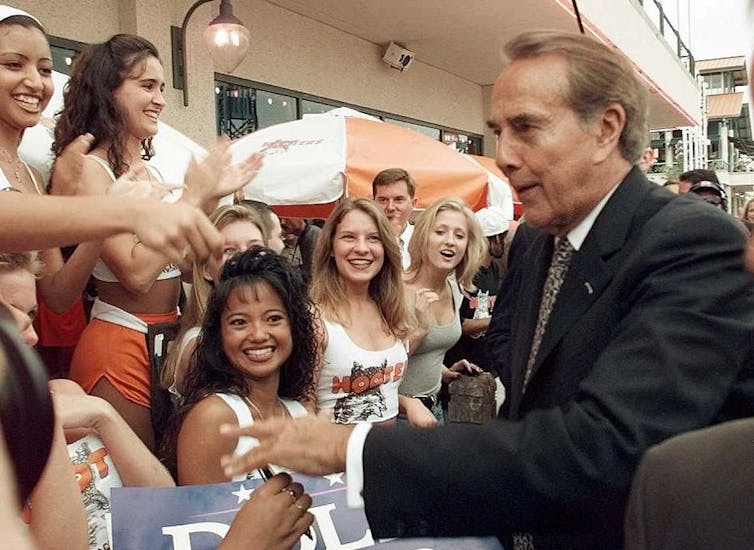
Older man in suit greets crowd of young women dressed in white and orange.
GOP presidential candidate Bob Dole shakes hands with Hooters employees after a campaign rally in Jacksonville, Fla., in 1996. J. David Ake/AFP via Getty Images

You might assume that managers, aware that their scantily clad employees would be more likely to face harassment, would try to set boundaries and throw out customers who treated servers poorly. But we found that waitresses at breastaurants have less support from both management and their co-workers than servers at other restaurants.

“Unfortunately, the girls are a dime a dozen, and that’s how they’re treated,” a former server and corporate trainer at a breastaurant explained.

The lack of co-worker support might also come as a surprise. Rather than standing in solidarity, the servers tended to compete for favoritism, better shifts and raises from their bosses. Gossiping, name-calling and scapegoating were commonplace.

The psychological toll

My research team also wanted to learn more about the specific emotional and psychological costs of working in these types of environments.

Psychologists Barbara Fredrickson and Tomi-Ann Robert have found that mental health problems that disproportionately affect women often coincide with sexual objectification.

So we weren’t surprised to find that servers working in sexually objectifying restaurant environments, such as Hooters and Twin Peaks, reported more symptoms of depression, anxiety and disordered eating than those working in other restaurants. In addition, they wanted to be thinner, were more likely to monitor their weight and appearance, and were more dissatisfied with their bodies. Hooters didn’t reply to a request for comment on this story.

Why are women drawn to the job?

Given our findings, you might wonder why any women would choose to work in places like Hooters in the first place.

The women we interviewed said that they sought work in breastaurants to make more money and have more flexibility.

A number of servers in one of our studies noted that they could make more money this way than waitressing at a regular restaurant or in other “real” jobs.

For example, one of the servers we interviewed used to work at a more run-of-the-mill restaurant.

“It was OK, I made OK money,” she told us. “But working at Hooters … I’ve walked out with hundreds of dollars in one shift.”

All the women we interviewed were in college or were mothers. So they enjoyed the high degree of flexibility in their work schedule that breastaurants provided.

Finally, several of them had previously experienced objectification while growing up, or they’d participated in activities centered on physical appearance, such as beauty pageants and cheerleading. This likely contributed to their decision to work at a Hooters or one of its competitors: They’d been objectified as adolescents, and so they found themselves drawn to these kinds of setting as adults.

Even so, our research suggests that the financial rewards and flexibility of working in breastaurants probably aren’t worth the potential psychological costs.The Conversation

Dawn Szymanski, Professor of Psychology, University of Tennessee

This article is republished from The Conversation under a Creative Commons license. Read the original article.

Filed Under: Faculty News, Featured

Call for Proposals: Connecting Across Disciplines 2025 Conference

Call for Proposals: Connecting Across Disciplines 2025 Conference

November 20, 2024 by Logan Judy

no photo available

Call for Proposals: Connecting Across Disciplines 2025 Conference

Profile

Filed Under: Faculty News, Featured, Student News

Adams Expands Research Flock with Latvian Fulbright Experience

Adams Expands Research Flock with Latvian Fulbright Experience

October 23, 2024 by Logan Judy

no photo available

Adams Expands Research Flock with Latvian Fulbright Experience

Profile

Filed Under: Featured, Student News

Thomas Retires as UT Psychology Admin

Thomas Retires as UT Psychology Admin

August 30, 2024 by Logan Judy

no photo available

Thomas Retires as UT Psychology Admin

Profile

When Sandy Thomas was looking for a job in 1986, a good friend encouraged her to apply at the University of Tennessee, Knoxville. Because of the people in the Department of Psychology and Neuroscience, she stayed for 38 years.

Thomas started as a “suite secretary,” sharing responsibilities with another staff member and working with about half a dozen professors. After a while she started working for the director of undergraduate studies, and her responsibilities evolved to include scheduling and registration. She was an administrative specialist before her retirement in August, also serving as a departmental liaison for students and planning the annual awards night. 

“Working with students is one of the main reasons I stayed at UT,” Thomas said.

They appreciated her too, with several naming her in the acknowledgements of their doctoral dissertations. Before the work moved to personal computers, Thomas explained, she typed many graduate students’ dissertations.

Thomas also represented the College of Arts and Sciences for numerous years on the Employee Relations Committee (ERC). “I feel that the ERC is a very important outlet for staff to voice their concerns as well as share ideas to help make changes to benefit all staff,” she said.

“UT is a great place to work,” she said. “It is not always perfect, but just have patience and work through any rough times,” she advised. “It will be worth it.”

By Amy Beth Miller

Filed Under: Featured, Staff

  • 1
  • 2
  • Next Page »

Recent Posts

  • Burghardt Honored with Herpetology Award
  • Survivor Support: Getting Language Right
  • Students, Faculty, and Alumni Making an Impact
  • Welsh’s Legacy Honored with New Scholarship
  • Cao’s Cognitive Science Contributes to AI Initiative

Recent Comments

No comments to show.

College of Arts & Sciences

117 Natalie L. Haslam Music Center
1741 Volunteer Blvd.
Knoxville TN 37996-2600

Phone: 865-974-3241

Archives

  • August 2026
  • May 2026
  • March 2026
  • October 2025
  • September 2025
  • July 2025
  • June 2025
  • April 2025
  • January 2025
  • December 2024
  • November 2024
  • October 2024
  • August 2024
  • July 2024
  • May 2024
  • March 2024
  • February 2024
  • January 2024
  • December 2023
  • July 2023
  • May 2023
  • April 2023
  • February 2023

Categories

  • Faculty
  • Faculty News
  • Featured
  • Newsletter
  • Staff
  • Student News
  • Uncategorized

Copyright © 2026 · University of Tennessee, Knoxville WDS Genesis Child on Genesis Framework · WordPress · Log in

Department of Psychology & Neuroscience

College of Arts and Sciences

Austin Peay Building,
1404 Circle Dr
Knoxville, TN 37916

Phone: 865-974-3328

The University of Tennessee, Knoxville
Knoxville, Tennessee 37996
865-974-1000

The flagship campus of the University of Tennessee System and partner in the Tennessee Transfer Pathway.

ADA Privacy Safety Title IX